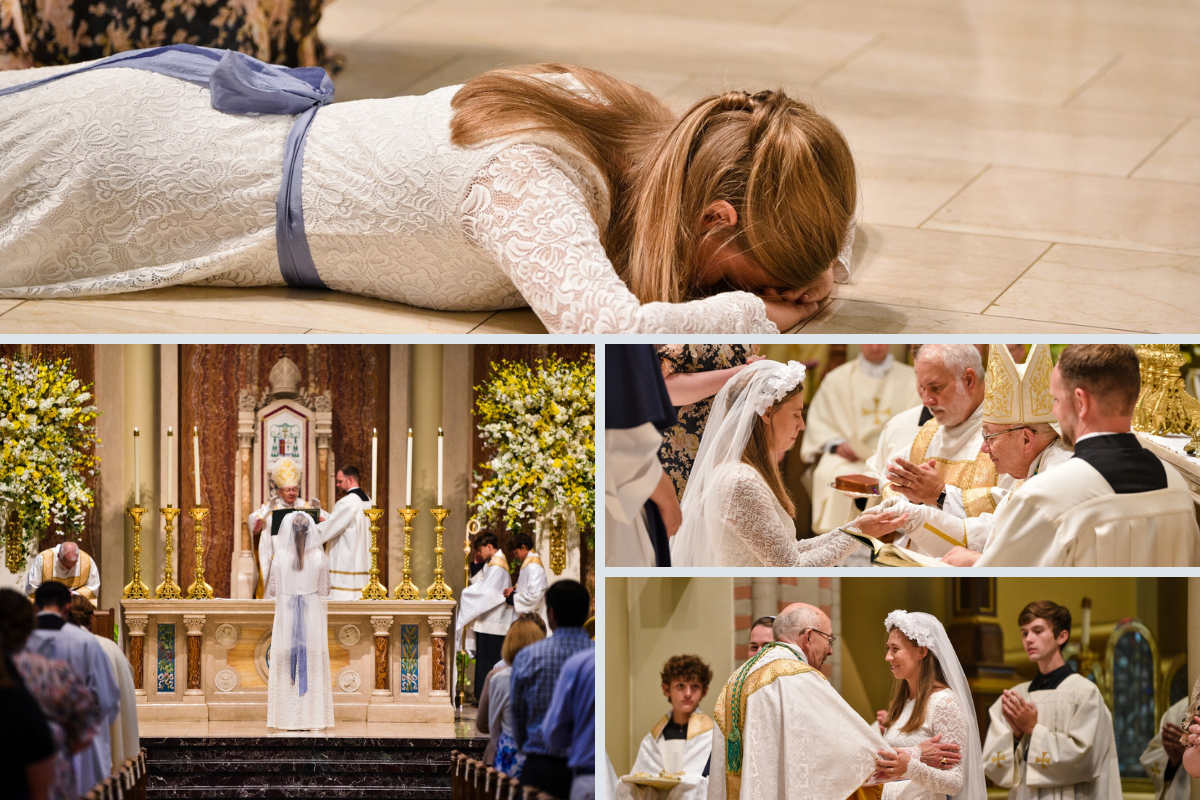
The charism of consecrated virgins is to devote themselves fully to Christ and His Church through a life of perpetual virginity, prayer, penance, and apostolic service, while remaining integrated into secular life. Their mission includes:
Prayer and contemplation: living a life rooted in Eucharist, Liturgy of the Hours, and private prayer.
Apostolic witness: evangelization, catechesis, works of charity, and example of total dedication to Christ in daily life.
Integration in society: living among family, neighbors, and co-workers, offering a visible witness to the Gospel in ordinary secular circumstances.
Consecrated Virginity is a form of secular consecrated life recognized by the Church under canon 604 of the 1983 Code of Canon Law. It is distinct from religious life because these virgins live in the world, not in a religious community, and do not take the public vows of poverty, chastity, and obedience typical of monks or nuns.
The vocation of consecrated virginity dates back to the early Church, with women dedicating their virginity to Christ while living in their own homes or among the community, rather than entering a convent. Over centuries, the Church formalized this vocation with liturgical consecration, making these women “brides of Christ” in a solemn rite approved by the diocesan bishop. Canonical recognition evolved to distinguish them clearly from nuns and sisters, particularly after the reforms of the Second Vatican Council.
Today, consecrated virgins are under the pastoral care of their local diocesan bishop, and the Church celebrates their consecration through a public liturgical rite during Mass. They may pursue secular careers, education, or community work, but their life is fully oriented toward Christ, marked by perpetual virginity, prayer, and service. The vocation continues to grow worldwide, with virgins living in every continent, demonstrating that consecrated life is not limited to cloistered religious communities.
Interested women must be at least 23 years old, baptized, faithful to the Church, and able to live the vocation fully. Application is made through the local diocesan bishop, who oversees formation and approves the consecration.